Alshariyfa “Missy” Robinson

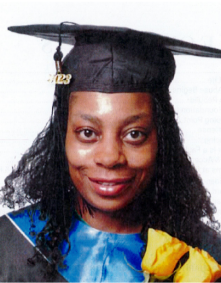
"Missy dreams of advocating for prison reform by addressing the often over looked topic of domestic violence."
Missy's Story
Alshariyfa “Missy” Robinson grew up in an environment rife with drugs and violence. At home, Missy’s stepfather was so violent that Missy’s mother had no choice but to leave him. As a young woman Missy became involved in physically and emotionally abusive relationships. Missy had her first child right after her high school graduation and began raising him as a single parent. A year later, Missy thought she had found a reliable father figure to help her raise her child.
Unfortunately, this relationship quickly became economically, physically, reproductively, and sexually abusive. Missy was forced to hand over her hard-earned paychecks. He kicked Missy out of her own home on multiple occasions, leaving her and her children periodically homeless. Inevitably she would return when he asked because she had nowhere else to go. After eight years of abuse and fearing for her life after a violent attack, she finally worked up the courage to leave.
She spent the next eight years rebuilding her life. She found a steady job, where she worked her way up to a supervisory position, which enabled her to buy a foreclosed house for herself and her four children. Unfortunately, Missy found herself in another abusive relationship. However, since domestic violence was not something people spoke about, Missy never discussed her experiences with anyone. She was determined to not be a victim this time around but not knowing how to leave she chose to fight back.
The years of abuse brought Missy to a tipping point, and she retaliated against her abuser. After a night out she lit a part of his house on fire hoping it would make him angry enough to leave her. Regrettably, the fire grew out of control, tragically taking the life of two residents who couldn’t escape the fire.
At 40 years old, Missy was convicted of second-degree murder and arson. Missy was sentenced to fifteen years to life. Today, Missy has been incarcerated for nine years and will not be eligible for parole until 2030, when she is 55 years old.
Prior to her incarceration, Missy tried to find solace in strength through her faith but the abuse she was experiencing pulled her away from the church. During Missy’s incarceration, she turned back to the faith she once lost to help her cope with the trauma of life behind bars. If Missy could go back and give her younger self advice, she would tell her to “stay in church.” Her faith has also supported her through family hardships and not being able to be home to support her children, mother, or grandmother. There’s only so much she can do over the phone or on the occasional visit when her family can make the over six-hour drive from Buffalo all the way to Bedford Hills.

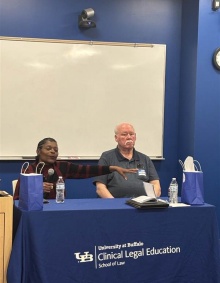
Missy Robinson's mother, Donna Robinson, speaking at the I AM Campaign event on April 18, 2025.
Since she cannot be as present for her family as she wishes, Missy devotes her time to mentoring young women who are recently incarcerated. As an intake receptionist, Missy helps orient the women coming to Bedford Hills for the first time or returning to the facility. Among many things, she issues incoming incarcerated people their new clothing, provides information on the facility and programs offered, and helps them get settled in. In this role, Missy believes her job is to “get them ready” for incarceration. Missy sees a lot of scared women coming into Bedford and she tries to encourage them. Missy advises them to “stay busy”, engage in programs, and “behave” so they can get back to their families as quickly as possible. Most importantly, Missy encourages the women to hold tightly to the positive attributes they bring with them into the facility.
Missy finds her mentoring work particularly rewarding because no one was there to mentor her when she first arrived at Bedford. She had no idea what to do or how to navigate life in prison. All she was told was to “sign up for programs” and hope for the best. Missy’s role as an intake receptionist allows her to be the mentor in the facility that she never had.
Since Missy did not have a mentor, she had to look inward for motivation to grow and change throughout her incarceration. Starting with her education, Missy initially joined the social science college program just to keep busy. However, she became discouraged as she struggled through the coursework. Missy was lucky enough to have other classmates and a professor who encouraged her to keep going. Before she knew it, Missy earned her degree in social science. She felt so much pride walking across the stage at graduation in May of 2023.
Missy also attributes her growth to her participation in numerous programs, including a church initiative, a print shop, and an anger management program. Through her programming, Missy learned techniques for de-escalating situations, self-awareness, and emotional regulation. She has found work in the domestic violence program particularly rewarding. Like many women who take the program, it was not until she came to prison that she realized that her prior relationships were abusive. Growing up, having physically or emotionally abusive partners was the norm.
Inspired by her own story, Missy dreams of advocating for prison reform by addressing the often over looked topic of domestic violence. She feels a deep calling to shed light on identifying domestic violence, aiming to prevent cycles of violence before they begin.
Missy describes herself as bubbly and resilient, prioritizing self-rehabilitation and happiness. The love for her four adult children and three grandchildren is a constant source of strength, and she cherishes every visit—whether in person or through video calls. “They’re everything. I love them so much,” she says, expressing the profound joy they bring to her life. For Missy, motherhood remains one of her greatest honors. Like so many women in Bedford, Missy knows all too well how tough it is to be away from her children, no matter how old they are. She urges newly incarcerated mothers to keep their focus on their children, emphasizing the importance of maintaining connections through frequent visits and phone calls. She also encourages these women to do all they can to get back to their families as quickly as possible.
For Missy, she looks forward to the day where she is reunited with her family, and she is finally able to hug her children and grandchildren and see her grandmother before she passes. She can’t wait to hold them close and share the love that has sustained her throughout her journey. Although prison has been one of the most difficult experiences of her life, Missy has met some wonderful women who have helped her get through each day. If she is released, Missy hopes to continue her advocacy work in the community, by joining RAPP to help the people she will leave behind.