Chelsea Kuss

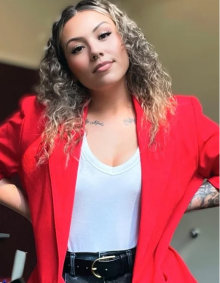
"Chelsea has come to realize that she is not defined by the worst moment of her life despite how others made her feel. As she sees it, there is so much more to people than what you see or what they have done in their lives. "
Chelsea's Story
Chelsea was in her first year of college when she was incarcerated for the first time. At only 17- years old, Chelsea was convicted of aggravated vehicular homicide after a drunk driving accident in which she lost her close friend. She was sentenced to 3 1/3-to-10-years. After serving almost six years, Chelsea was released from prison for the first time and immediately found a job and went back to school for cosmetology. However, still reeling from the impact of causing her friend’s death and the trauma of incarceration, Chelsea turned to alcohol to cope. This led to another terrible decision. In 2019, Chelsea was convicted for driving while intoxicated and received a 1–3-year sentence, of which she served two years.
As Chelsea describes, being incarcerated for a second time as an adult was different; she had to deal with the PTSD that resulted from her first sentence while also facing the trauma, guilt and shame of a second sentence. In particular, Chelsea was severely affected by being away from her family for such a long period of time. While the instant offense led to backlash against Chelsea herself, the backlash also came against Chelsea’s family. The guilt Chelsea felt for her instant offense was compounded by the guilt she felt for the stigma attributed to her parents.
As such, Chelsea worked to improve herself as much as possible so that she could get home to her parents and tell them that the instant offense was not their fault. During her first sentence, Chelsea attempted to enroll in a college program as soon as possible. However, she was told that it was “too early” for her to start school due to her “earliest release date” and she had to wait two years to begin the program. Once she did start school, Chelsea would stay on the phone with her mother as much as possible so that her mother could help with research and school projects. Chelsea is adamant she would not have gotten through school or prison without the support of her parents.
Chelsea became involved in facility programs and even became a group facilitator. For example, Chelsea worked with the Transitional Service Program, a program run by DOCCS that is designed to assist in preparing individuals to return to their community. In particular, Chelsea assisted individuals in their efforts to re-enter society, which included helping people find an approved address at which they could live upon release and conducting mock job interviews to prepare for the real thing.
In addition, Chelsea was also involved in Aggression Replacement Training (ART), a program that helps incarcerated people to learn what causes them to act aggressively, how to manage their negative emotions, and how to make better choices in the future.
Despite her experiences with programming inside of prison, Chelsea took note of the issues plaguing these programs. Many of the programs are considered “mandatory” for certain incarcerated people based on the crimes for which they are convicted. In other words, people are forced to participate in programs that are not geared towards the particular issues or traumatic experiences that led to their incarceration. In addition, Chelsea notes a general apathy amongst group facilitators and counselors in that they were only present because it was their job; they did not truly care about the people there nor what these people were going through. Furthermore, the counselors and facilitators did not understand the experience of incarceration and did not want to take the time to provide person-centered care.
In addition to the issues with programming, Chelsea also recognized the issues plaguing incarcerated women in general. Specifically, Chelsea saw the struggles incarcerated mothers faced just to try to see their children. Women often lost their connection to their children. Given the importance of her family’s support while incarcerated, Chelsea felt particularly heartbroken for these women.
Upon her release in 2021, Chelsea continued to keep improving her life. As of today, Chelsea is a Credentialed Alcoholism and Substance Abuse Counselor (CASAC). She works for the Center for Community Alternatives, Inc., an organization focused on providing programs and services to reduce incarceration, advocating for those facing poverty, addiction and violence within their communities, and helping formerly incarcerated people reintegrate into society. Chelsea currently works as a Recovery Care Manager in Rochester, NY. In addition, Chelsea has done re-entry work for formerly incarcerated individuals while working for Delphi Rise, a community-based substance abuse treatment and support organization.
Chelsea describes herself as career-driven and gains inspiration by helping her clients, even if it’s through small actions. Remembering what it was like working with counselors who didn’t understand where she was coming from, Chelsea often tries to be “real” with her clients by being honest with them and trying to get to know them and their struggles on a deeper level.
Chelsea will often tell her clients that she will help them, but she will not do the work for them. Instead, Chelsea encourages her clients to do the majority of work themselves much like she did. Yet, Chelsea will always do the best work possible for her clients; if she does not have an answer to a question, she will do everything she can to find that answer.
Chelsea considers herself lucky to have had the support of her family both during and after her incarceration. In the future, Chelsea wishes to further her education and to step back from case management to build stronger re-entry programs for people so they can receive the financial and emotional support they need.
Over the past decade, Chelsea has come to realize that she is not defined by the worst moment of her life despite how others made her feel. As she sees it, there is so much more to people than what you see or what they have done in their lives. Chelsea met some of the best people in her life while she was incarcerated. Chelsea hopes that through the passage of the Fair and Timely Parole Bill and the Elder Parole Bill, individuals will get a chance to go home to their families.
“We delight in the beauty of the butterfly, but rarely acknowledge the changes it goes through to achieve that beauty.” – Maya Angelou