Jerome Wright


From Left to Right: Associate Professor and Director of the Criminal Justice Advocacy Clinic, Alexandra Harrington; Jerome Wright; Staff Attorney, Annabel Mirales.
Jerome wants people to know one thing: “Aristotle once said that ‘poverty is the parent to both crime and rebellion.’ If you want to end crime . . . end poverty.”
Jerome's Story
Jerome was a strong student, consistently making the honor roll and Dean’s list. In high school, he was a star basketball player and track and field record holder. However, with little guidance on what to do with this potential, Jerome was pulled into the streets, where this potential slowly faded away. At 18 years old, reality came crashing down on the once promising student-athlete: Jerome was sentenced to 18 and ½ years to life for second-degree murder.
In the first half of his incarceration, Jerome continued to make poor choices. He often found himself in solitary confinement. In solitary, he was locked in a cell alone for 23 to 24 hours a day. While he was supposed to get one hour of recreation time a day, that rarely happened. When it did, it was spent inside of a four-walled yard. Additionally, while he was allowed family visits, he could only see them while in shackles and from behind plexiglass.
In that stillness, Jerome wrestled with a question that would haunt him: did he want to continue down a path of selfishness, self-destruction, and despair? It was in this dark hour that a flicker of hope ignited within him. He realized he could choose to transform his life instead of letting it wither away. Determined to change, Jerome immersed himself in every program—anger management, substance abuse counseling, and academic courses.
Interested in furthering his education, Jerome enrolled in classes at Skidmore College and Dutchess Community College, realizing that education could be his lifeline. Over the years, as he grew into a husband, father, and grandfather, he began to understand the weight of his responsibilities. Jerome was no longer only accountable for himself; he was a part of a family that loved him, and he couldn’t keep blaming others for the choices he had made.


Jerome Wright at Parole Advocacy Day in Albany, New York with a student attorney and Alexandra Harrington, Director of the Criminal Justice Advocacy Clinic.
With the weight of the past still with him, Jerome found purpose in social justice. Knowing first-hand the detrimental effects of being isolated for extended periods of time after spending years in solitary, Jerome became the co-director of the #HALT solitary confinement campaign of Western New York. Jerome played a pivotal role in getting the HALT Solitary Confinement Act passed which restricts the use of solitary, restricts the maximum time a person can be segregated, and requires incarcerated individuals continue receiving programming while segregated.
Jerome is the co-director of the NYS Jails Justice Network, which established a network of county jail representatives. This role is important to Jerome because of the realization that more people go to jail than prison. Thus, improving county jails presents a massive opportunity to make more impactful changes. Because each county jail is largely autonomous and overseen by the county sheriff, the goal in the JJN is to bring uniformity to county jails in New York State.
Jerome is also the Executive Director and Founder of the Mentoring and Nurturing (M.A.N.) Program, created in the 1990’s. This mentorship program was used to help people on the inside get better with role models they could positively emulate. Since his release, M.A.N. has been used effectively in schools, churches, community centers, reentry programs and the courts.

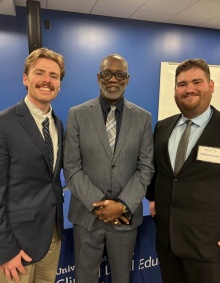
Jerome Wright with student attorneys Edward LaDuca '26 and William Hecht '25.
With his past shaping his mission, Jerome passionately advocates for parole justice reform. He believes parole reform bills, such as the Fair and Timely Bill and the Elder Parole Bill, can provide a glimmer of hope for others. His goal is to encourage those who are preparing to face the parole board to set goals and strive for a better life. As the creator of the “I AM” Campaign, Jerome seeks to amplify the voices of those who are incarcerated, showcasing their potential for goodness rather than defining them by their past mistakes. He understands the need for accountability, but he also knows that the system must be fairer, allowing for the release of those who have truly transformed.
Jerome hopes that when people see someone who has been incarcerated, they will look beyond the worst thing they have done and recognize the person they are today. In a world that often seems quick to judge, Jerome stands as a powerful reminder of the capacity for change, rehabilitation, redemption, and, ultimately, compassion.
Jerome wants people to know one thing: “Aristotle once said that ‘poverty is the parent to both crime and rebellion.’ If you want to end crime . . . end poverty.”

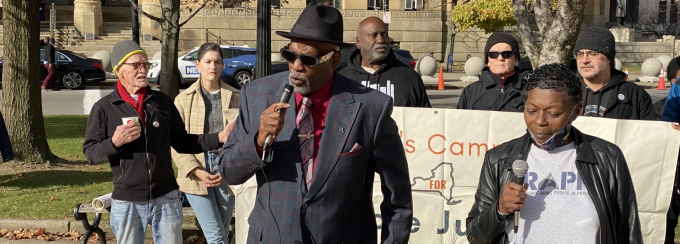
Jerome Wright giving a speech at a People's Campaign for Parole Justice event.
After serving his minimum sentence of 18 ½ years Jerome faced the parole board for the first time at 39 years old. After his first denial, Jerome went before the parole board five more times over the next ten years. He recalls how each appearance and subsequent denial was torture. Each time he came prepared with letters of support from his family and friends, certificates of accomplishments, and re-entry plans including job offers for if he was released.
Yet, when he was denied parole, it didn’t only affect himself. The companies who offered him jobs had to subsequently scramble to find a replacement after learning that Jerome would not be joining them. The repeated parole denials also took an emotional toll on Jerome’s family and friends on the outside. But what disturbed Jerome most was the realization that the Board would never see past his crime. In the parole board’s eyes, he would never be anything more than the worst thing he had ever done.
Jerome knew he would need to prove his rehabilitation to others if he was to have a chance at parole. Through his job in the law library, Jerome improved his legal writing skills and wrote a parole appeal that thoroughly impressed the Judge who read it. Despite pro se appeals always being decided on the papers, the Judge scheduled oral arguments for Jerome to come to court to argue his case. Jerome’s appeal and performance in court led to a new parole hearing and his eventual release, as the Judge recognized Jerome’s merit beyond the actions of his 18-year-old self.
In his last parole hearing, Jerome felt as if he was “dragged through the mud.” The board attempted to anger Jerome into an outburst that would justify denying him parole again. But Jerome remained steadfast in his belief that he was more than the worst decision he had ever made. Jerome was released on parole after that sixth hearing. After 28 years, a decade beyond his minimum sentence, Jerome walked out of prison at 48 years old. Jerome was determined to make up for lost time with his family, cherishing the laughter and love that surrounded him. Perhaps the most profound joy in Jerome’s new life came from his role as a grandfather. Every moment spent with his grandchildren fills his heart with a gratitude he had never fully understood before.
Interested in furthering his education, Jerome enrolled in classes at Skidmore College and Dutchess Community College, realizing that education could be his lifeline. Over the years, as he grew into a husband, father, and grandfather, he began to understand the weight of his responsibilities. Jerome was no longer only accountable for himself; he was a part of a family that loved him, and he couldn’t keep blaming others for the choices he had made.