Thomas Gant

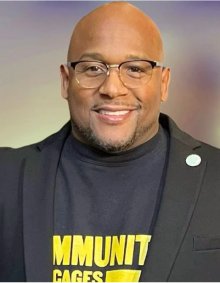
“These bills give people hope. The worst thing you can do to any person is take their hope away.”
Thomas' Story
Growing up on the East side of Buffalo, Thomas had a relatively normal childhood. He was a boy scout and participated in extra-curricular activities at school. It wasn’t until he graduated high school that he chose to embrace life on the streets. Not really sure where his life was going, Thomas got caught up in a gang. In 1998, after an escalation of territory issues with a rival gang, Thomas shot and killed one of the rival gang members. At 21 years old, Thomas was found guilty of second-degree murder and was sentenced to 25 years to life.
Despite being incarcerated, Thomas felt that he could still set an example for his children, and in order to do that he couldn’t “tell [his] kids to do the right thing if [he was] not doing the right thing.” Thus, Thomas devoted his time to his own rehabilitation. He continued his education and earned a degree from Genesee Community College, where he learned a lot about technology and sign language. In fact, Thomas became a certified ASL interpreter because many of the people in his class were deaf and he wanted to support them in any way possible. In addition to college, Thomas participated in an Alternatives to Violence (“AVP”) program, in which he took a workshop on managing negative emotions. Thomas was also on the Inmate Liaison Committee, which facilitates communication between incarcerated individuals and facility administrators for the purpose of improving the general welfare of the incarcerated population in the facility.
Through this work, Thomas began to notice the uptick in youth violence both in gangs and in prison. Thus, Thomas began a Youth Assistance Program (“YAP”) at Wende Correctional designed around mentoring at-risk youth and dissuading them from taking similar paths to those currently incarcerated. YAP demonstrated how different factors –– family issues, lack of education, peer issues, and substance abuse –– can lead to criminal behavior amongst younger people. Through YAP, Thomas promoted a new paradigm for “respect” with one basic idea: every human being automatically deserves respect and that it shouldn’t have to be earned. Between the years of 2000 and 2015, Thomas spoke with approximately 100,000 to 175,000 youth about community-based programming and alternatives to violence.
One of the most impactful positions Thomas held during his incarceration was becoming a hospice aide. Though reluctant to take this role, it gave Thomas the chance to see both the immense fragility and immense value of life. In this role, Thomas read patients their mail and helped them write responses to their loved ones. He fed them, cleaned up after them, and prayed with them. Thomas also reflected on his own family’s experience with hospice and even though he couldn’t be there for his family, he realized he could be there for the incarcerated individuals who had no one else.

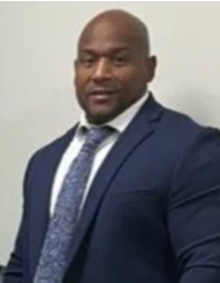
Despite his successes, Thomas describes prison as a place where every day feels identical to the one before while the world outside keeps on moving. Thomas had to overcome the challenge of not being there for his son who was shot, having his clemency application rejected, and watching COVID ravage the world while all he could do was watch. All of these hardships often made Thomas feel hopeless in his situation.
However, watching his loved ones continue to fight for him on the outside rekindled Thomas’s sense of hope; he called their support an “injection in the arm to push him through the finish line.” One of the major forces fighting for Thomas was his family, including his wife, Kerry, as well as his five children and eleven grandchildren. As Thomas’ first parole hearing approached, Kerry put in a great amount of effort in preparing for his re-entry into the community. She reached out to numerous organizations to help secure job offers for Thomas that enabled him to start working as soon as he was released. Now that he is home, Kerry no longer feels the exhaustion of being Thomas’s sole emotional support and feels that her life has completely changed since having Thomas home to help take care of their children and their home.
Upon his release, Thomas found that he wanted to continue being an advocate. He currently works as a Community Organizer for Center for Community Alternatives (“CCA”), a program that assists people who have been negatively impacted by the criminal justice system through direct action, such as advocating for those currently incarcerated, offering re-entry services to formerly incarcerated people, and promoting alternatives to incarceration (mental health support, substance abuse treatment, etc.).
Through CCA, Thomas participates in Communities Not Cages (“CNC”), a grassroots campaign that fights to end mass incarceration and to overhaul sentencing laws in New York. In particular, Thomas’ work in the campaign involves attempting to pass a number of bills: The Marvin Mayfield Act, which would eliminate mandatory minimum sentences and allow judges to consider mitigating factors in a case (e.g. drug abuse, mental health issues, etc.) for the purpose of reducing excessive sentences; the Second Look Act, which would allow incarcerated people to petition for resentencing after serving either 10 years or half of their sentence; and the Earned Time Act, which would allow incarcerated individuals to earn time off of their sentences by engaging in good behavior and participating in rehabilitative programs, including those centered on education and vocational training.

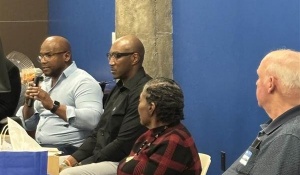
From Left to Right: Thomas Gant; Walter Ball; Donna Robinson; and George Schreier at the "I AM" Campaign event.
In addition, Thomas is also a Re-Entry Coordinator for the Rochester Education Justice Initiative (“R.E.J.I.”) at the University of Rochester. This program focuses on providing continued education to incarcerated people and supporting formerly incarcerated people in pursuing higher education. Through this position, Thomas mentors formerly incarcerated individuals who are pursuing higher education and helps connect them to different services in Rochester. Thomas also continues to mentor at-risk-youth by encouraging nonviolence and demystifying the “coolness” of prison.
Since his incarceration, Thomas has carried with him a deep sense of remorse for his actions. He consistently deals with the fact that he was once a part of the violence that he works so hard to prevent and recognizes that he can never truly give proper recompence to the victim’s family. Thus, Thomas is constantly motivated to encourage non-violence in his advocacy work so that nobody else ends up in the same position as him or his victim.
Despite spending almost a quarter-century in prison, Thomas has held on to a hope that many others have struggled to keep. He truly believes that passage of both the Fair and Timely Parole Bill and the Elder Parole Bill will give currently incarcerated people hope for the possibility of returning home. He truly believes that once released they will do so much good contributing to their communities just as Thomas has done. Thomas aspires to bring that same feeling of hope he left Wende Correctional Facility with in 2022 to so many others who are currently incarcerated.
“These bills give people hope. The worst thing you can do to any person is take their hope away.” – Thomas Gant