
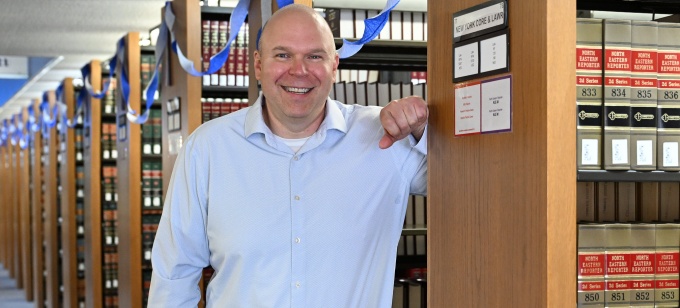
Beyond the Books
Brian Detweiler receives SUNY Chancellor’s Award for Excellence in Librarianship
Brian Detweiler has spent more than a decade helping shape the Charles B. Sears Law Library into what many UB Law students consider a true “home away from home.” Known for his approachable style and signature introduction, “I am your librarian,” Detweiler has built a reputation as a trusted guide, mentor and advocate for students navigating the demands of legal education.
Since arriving at UB in 2014 as the Law Library’s first Student Services Librarian, he has focused on ensuring that the library continually evolves to meet students’ needs, gathering feedback through focus groups and surveys that helped inform initiatives such as 24/7 library access and designated collaborative study spaces.
Today, as associate director and associate librarian of the Charles B. Sears Law Library, Detweiler plays a key leadership role in the library’s operations, supervising staff and overseeing the selection, organization and management of the library’s collections. Colleagues praise both his student-centered approach and his command of legal research. For SUNY Distinguished Librarian Elizabeth Adelman, vice dean for legal information services and director of the Charles B. Sears Law Library, Detweiler’s impact is matched by his extensive expertise. “He has an encyclopedic knowledge of the many sources and methods available to research the law and related disciplines and stays abreast of new developments,” she says.
That combination of leadership, service and expertise recently earned Detweiler one of SUNY’s highest honors: the SUNY Chancellor’s Award for Excellence in Librarianship, which recognizes exceptional achievement in one of just five categories of SUNY-wide distinction. We caught up with Brian to talk about the recognition, reflect on his career, and discuss what it means to be a law librarian in 2026.
Q: How did you become interested in law librarianship in the first place?
A: My first job as an attorney was practicing at the Legal Aid Society of Rochester representing victims of domestic violence. And while it could often be very gratifying, it was also very stressful. I’m not a born litigator, but I found I really enjoyed the research and writing side of practice, so I decided to look into librarianship as a career path. I was accepted to the University at Buffalo’s master’s program in library science and was able to intern here at the law library while working towards my degree. I really liked the environment and the people, so when I got the opportunity to return to UB after a couple of years at St. Mary’s Law School in San Antonio, it was a no-brainer. I’ve been here ever since.
Q: You have received the SUNY Chancellor's Award for Excellence in Librarianship. What did that recognition mean to you?
A: It was a tremendous honor, and it means a lot to me to receive this recognition from my colleagues. I think everything was basically shepherded through by my director, Beth Adelman, who's amazing to work with, and Beth was able to find support from some faculty members I’ve worked closely with in the law school, so I am very appreciative of their support and for all my great coworkers since so much of what we do here is a team effort.
Q: You, Beth Adelman and three others are co-authors of the book “New York Legal Research,” the fifth edition of which was published on June 1. What are some of the new features or topics in this edition?
A: As you can imagine, we had to account for the emergence of AI since our last edition published in 2020 as well as some other changes to the major legal research databases, Lexis and Westlaw. We also added an interesting new chapter on Native American law, which was authored by my colleague Rebecca Chapman, our Undergraduate Law and Indigenous Outreach Librarian. Rebecca has been at the forefront of increasing the visibility of Native American law in the legal information field, and to my knowledge, ours is the first title in the series that includes a chapter like this, which is very exciting.
Q: How is artificial intelligence changing legal research, and what do you think law students need to understand about using AI responsibly?
A: AI is an important tool. It can serve as a starting point for researching an issue before pivoting to traditional sources, or better yet, provide some reassurance towards the end of the research process that you’ve considered every angle of your issue and didn’t overlook any important sources. AI should be looked at as one of many tools in your arsenal. It can help you work more efficiently, but it is also a tool that can hurt you if you use it irresponsibly. That’s why we focus on teaching students the traditional way to do research before we teach them about using the AI tools on Lexis and Westlaw in our first-year legal research class.
Q: What are you and your colleagues at the law library currently working on that students, faculty or alumni might find particularly interesting?
A: One thing that our alumni in particular may not be aware of is that the law library now has a dedicated Law Practice Technologist on staff, Latasha Towles. Latasha’s job is to keep tabs on the latest and greatest developments in legal technology and to incorporate that training into the law school curriculum so our graduates will be prepared for the technologies they will encounter in practice. These range from practice management and office productivity software to different AI products on the market.
Q: What can an experienced law librarian find or recognize that a good Google search—or an AI system—might miss?
A: Legal research is very much an iterative process, so even the best search on Google or Lexis, or prompt entered into an AI platform, should only ever be a starting point in a research process that will include consulting and analyzing various primary and secondary sources and validating any legal authority that will be relied on. Despite how impressive AI can seem at times and how much the technology has improved, law is still far too nuanced and dynamic to take human analysis out of the loop, which I think is good job security for all of us.