
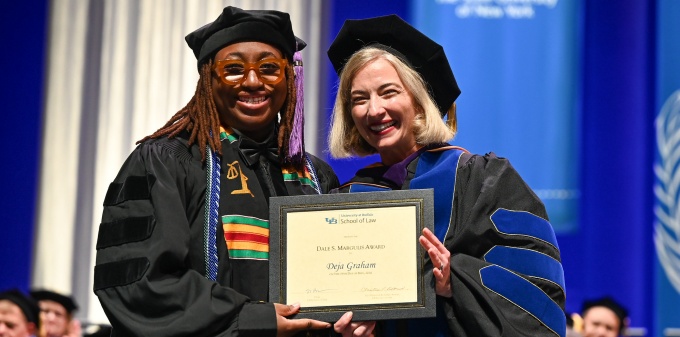
Professor Bartholomew presents Deja Graham with the Dale S. Margulis Award at the 2024 Commencement Ceremony.
Cleared for publication
Professor and former student co-author article on antitrust enforcement in the airline industry
Some academic projects satisfy a course requirement. Others spark an intellectual partnership that continues long after the semester ends.
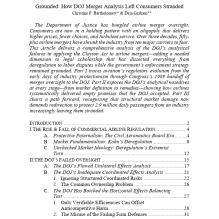
The latter was the case for Deja Graham ’24. What began as an independent study with Professor Christine Pedigo Bartholomew grew into a major research project on airline deregulation and antitrust enforcement – and ultimately into a co-authored article titled “Grounded: How DOJ Merger Analysis Left Consumers Stranded” that will appear this fall in the Villanova Law Review.
The article argues that the U.S. Department of Justice (DOJ), which evaluates proposed mergers mainly through its Antitrust Division, has failed to enforce antitrust laws effectively in the airline industry. The result has been decades of mergers that have reduced major carriers and created an oligopoly that harms consumers.
“As we were putting together the independent study, it was clear that this would make a really good article,” Bartholomew says. “Deja’s project was deeply researched. As we discussed various mergers, we quickly realized merger oversight in the airline industry had strayed far afield from the goals of antitrust.”
Two major airline cases attracted Graham’s attention as she began her research. In March 2023, the DOJ and several states sued to block a proposed merger between JetBlue Airways and Spirit Airlines. In January 2024, a federal judge ruled in favor of the DOJ, blocking the merger on antitrust grounds.

In August 2024, meanwhile, the DOJ allowed a merger between Alaska Airlines and Hawaiian Airlines to proceed.
“On paper the Alaska-Hawaiian deal is probably the more problematic merger,” Graham says, “because they directly competed on three different routes, and they were the only competition on those routes.”
In their article, Graham and Bartholomew trace the industry's evolution from heavy federal regulation under the Civil Aeronautics Board to airline deregulation beginning in 1978. Their article delves into the merger analysis used to approve many of the key mergers of the last 50 years. They argue that deregulation eventually gave way to excessive reliance on market forces, accompanied by decades of flawed merger analysis and weak antitrust enforcement.
When did the authors conclude that the problem was not deregulation itself, but the government's enforcement of antitrust laws?
“I think the thesis came into clarity once we started looking very carefully at the analysis the Department of Justice was using in these mergers and compared it to the merger approaches used in other types of industries,” Bartholomew says. “We recognized that the DOJ actually was not using its own standards in evaluating proposed mergers in the airline industry.”
Their collaboration included in-person meetings, phone calls, hundreds of text messages and what Bartholomew describes as “crazy long emails.”
“It was a very lovely writing experience,” Bartholomew says, “because Deja is so responsive and insightful. She was always willing to volley ideas. A past student becoming interested enough in a topic you teach to spend this amount of time on a project? For professors, this is what we live for.”
As a law student, Graham was the editor of the Buffalo Human Rights Law Review. She is now a law clerk for the New York State Supreme Court, Appellate Division, First Department. Graham and Bartholomew presented their scholarship in April at Loyola University's 26th Annual Antitrust Colloquium in Chicago, a major gathering of antitrust experts and scholars. Bartholomew also presented the research to the University of Southern California/Cambridge Antitrust Workshop.
The Chicago conference was a great experience, Graham says. “I’m sort of a junior scholar compared to the other people in the room. It was good to get feedback and realize my research is on the right path.”
Graham and Bartholomew were able to gather valuable feedback from antitrust scholars and state attorneys general as part of their process.
“By the time we finished the article, every section of that article was rewritten at least twice,” Bartholomew says. “Each time we presented or shared drafts, we received generous feedback from high-level authorities and other leading antitrust scholars. We used their feedback to rewrite and strengthen the piece.”
What influence might the article have on antitrust enforcement in the airline industry?
“I hope that some of the suggestions in our article can, at some level, be implemented for the sake of consumers,” Graham says. “Now that Spirit Airlines is out of business, flying has gotten a lot more expensive. Spirit was a market disruptor, and there is nothing left to replace it.”