

A ready reference on New York bail laws
Most criminal law practitioners, both prosecutors and defense attorneys, are well aware of recent legislation in New York State that mandates the pre-trial release of the majority of criminal defendants without bail. Putting that law into practice, though, has meant negotiating the details of how it’s applied and under what circumstances.

Order Barth’s Guide:
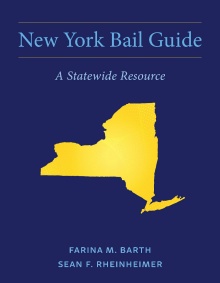
New York Bail Guide: A Statewide Resource
Authors: Farina M. Barth, Sean Rheinheimer.
Carolina Academic Press : 2026
They’ll find eminently useful guidance in Farina Barth’s new book, New York State Bail Guide: A Statewide Resource (Carolina Academic Press). Written with Sean Rheinheimer ’18, managing attorney of the Legal Aid Bureau of Buffalo, the book analyzes Article 510 of the state Criminal Procedure Law and clarifies its application.
Barth, professor of skills and a 2017 UB Law graduate, teaches first-year Legal Analysis, Writing and Research, as well as the upper-level course Wrongful Convictions. A former public defender, her research also focuses on wrongful conviction compensation.
New York State Bail Guide covers general provisions that may convert a non-qualifying offense into a qualifying one; a chart listing every Penal Law offense with its bail eligibility status; and a compilation of all relevant New York case law on bail.
We asked Barth to reflect on the project and how it can provide clarity in an era of bail reform in New York.
Your book focuses on Article 510 of the state Criminal Procedure Law. So it’s black-letter law. Why is your book needed?
The idea for this book is to serve as a treatise for those practicing criminal law in New York State post-2020. In 2020, our criminal procedure law as applied to monetary bail was significantly amended. Throughout the last six years, there have been significant amendments to the law as the law continues to evolve. This book hopefully will fill the gap for those practicing in our criminal courts by providing the most up-to-date guidance including statutory changes and developing case law.
Article 510 grants some leeway to courts on setting bail. Is your book mainly intended to help judges make those decisions?
The goal is broader. It is to help all participants in criminal courts across the state: judges, defense attorneys and prosecutors. I see each participant playing a critical role in criminal proceedings, and all can benefit from this guide. We also hope to reach law students and professors who plan to go into criminal practice.
You include a chart of every Penal Law offense with statutory references, as well as a compilation of New York case law on bail. That sounds like a huge amount of research—was that the most time-consuming part of the project?
The chart was the most labor-intensive part of the project, but it is also the most useful. Attorneys working in fast-paced court settings, such as arraignments, can quickly scan the chart, which is organized by Penal Law section rather than alphabetically, to determine whether an offense is a qualifying offense. This structure allows practitioners to locate the relevant statute and source quickly and make accurate decisions in fast-paced settings.
Your co-author, Sean Rheinheimer '18, practices with the Legal Aid Bureau of Buffalo. Why was it important to you to include the perspective of a criminal defense practitioner?
Sean and I worked together at Legal Aid for about four years, and he now serves as the managing attorney responsible for training new attorneys there. During our time working together, we both developed a deep appreciation for the research aspect of the job, and this project felt like a natural extension of our days working together.
His expertise working at Legal Aid has allowed us to keep track of any developments that help us maintain a website through our publisher that provides updates on the law. The Legal Aid Bureau of Buffalo is an invaluable institution in our community and has been deeply supportive of both this project and of Sean and me. I am also fortunate to serve on its board of directors.