
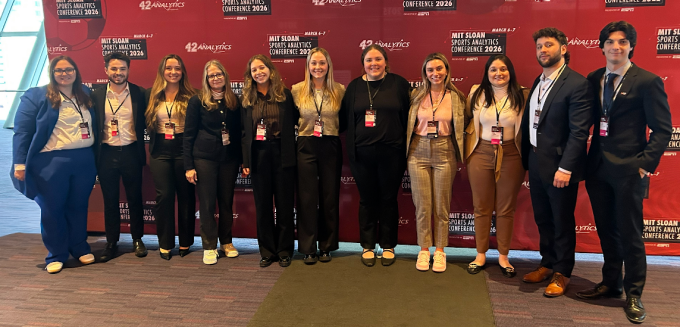
Photo courtesy of Jon Stevens and Stacy Walker.
Networking in the big leagues
Sports law students learn from the best
Soccer star Megan Rapinoe was there. So was NBA Commissioner Adam Silver. And former New York Times stats guru Nate Silver. And dozens more—pretty much all the key players in sports analytics.
And so were 10 UB Law students exploring the complexities of sports law. They mingled with dozens of prominent figures in the world of sports analytics at the MIT Sloan Sports Analytics Conference—a cavalcade of learning, new ideas and valuable professional networking.
The two-day conference took place March 6 and 7 in the Menino Convention Center in Boston. This was the fourth time Professor Helen “Nellie” Drew ’88, director of the UB Center for the Advancement of Sport, brought her sports law students to the event.
“It’s a phenomenal opportunity,” says Drew. “Everyone there is so open to meeting students and helping them find their way in the sports world.”
The experience, she says, does double duty: it introduces law students to the many different ways they might use their legal degree in the big-business world of professional and collegiate sports, and it gives them the chance to build the kind of deep, fast-paced network they need to break into the industry.


Stacy Walker '26
Attendees heard from panelists in such areas as artificial intelligence, the future of youth sports, revenue growth in women’s sports, and sports prediction markets. The UB Law students took it all in and returned with a renewed sense of excitement about the career possibilities in the field.
Third-year student Stacy Walker, who has a finance background, was drawn to presentations on private equity and the business side of sports. But there were so many panel options, “it was like choose your own adventure,” she says. She found herself fascinated by a panel centered on women’s hockey. Coaches and athletes “talked about how data can inform personnel decisions and inform athletes on how they should approach their training and recovery,” she says.


Mary Starr '26
“The Olympics just happened last month, and everyone was still celebrating the gold medal win. It was interesting to hear how the coaches made their decisions. One former Olympic athlete said she wished she had access to the data about her own performance that a lot of athletes have now because it would have made her a better athlete.”
For her classmate Mary Starr, one highlight was learning about developments in sports medicine. Through the law school’s Sports Law Clinic, Starr is working on a project examining a gap in trainer support for students in university-level dance programs.
A second high point included meeting her mentor—Stan Marks, director of business strategy and analytics for the Bruins and TD Garden. Starr was one of the select number of law students chosen to participate in the conference’s extensive mentoring program. Her main interest has long been hockey—“I always said my dream job was to be general counsel for the Boston Bruins,” she notes. “My new mentor has absolutely helped me to get a foot in the door already,” she says. And as a bonus, she was invited to network with Marks and other industry experts in a luxury suite at that night’s Boston Celtics game: “It was electric.”


Jon Stevens '27
Second-year student Jon Stevens was also accepted into the highly sought-after mentor program and matched with John McKeon, senior vice president for business intelligence and strategy with the NFL’s Arizona Cardinals. Stevens made full use of every networking opportunity, including during downtime between conference presentations. “There were industry leaders walking around and willing to talk to you,” he says. “They had helpful tips and they talked about how they got into their particular field. And there were several pop-up career tents—FanDuel, ESPN, Live Nation, Ticketmaster—where you could leave your resume to be added to their job portal.”
Stevens, who’s president of the Buffalo Sports and Entertainment Law Society, says the conference underscored the key roles that lawyers play in the business of sports. “A lot of the conversations didn’t focus specifically on law,” he says, “but you could easily extrapolate all the legal problems that could result.” As an example, he cited the massive amounts of data that pro teams compile every day on their players. “Is it a player’s right to have that data or can the team sell it to, say, FanDuel?” he asks. That’s a legal question as much as a business question, and an area he’s now even more eager to explore.