
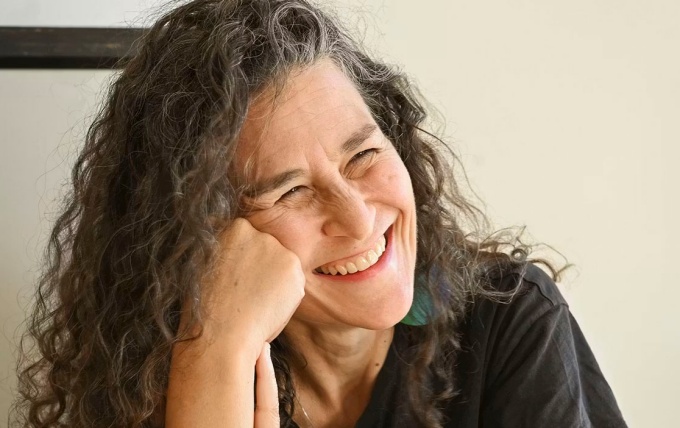
Braverman embarks on prestigious Radcliffe fellowship
SUNY Distinguished Professor Irus Braverman, the law school’s Dr. Teresa A. Miller Professor of Law, has been named a 2026-27 fellow of the Harvard-Radcliffe Institute, joining 53 scholars from across a multitude of disciplines to pursue boundary‑pushing research through the program.
The prestigious yearlong fellowship offers recipients the chance to advance a major project within one of the world’s leading centers for interdisciplinary inquiry. Each fellowship cohort draws leading scientists, writers, scholars, public intellectuals, and artists in the humanities, sciences, social sciences, and creative arts. Fellows gather in Cambridge from around the globe and spend the year immersed in a collaborative intellectual community.
As Braverman prepares for her time at Harvard, we invited her to reflect on the opportunity and her planned project on ecopastoralism in Palestine-Israel, which examines the role of settler shepherds and sheep in remaking the West Bank landscape.
What is ecopastoralism, and what questions does it raise in your project?
Ecopastoralism, as I use the term in my work, is a way of framing livestock herding as environmentally beneficial, sustainable and even restorative. Settler shepherds often describe their practices in terms of caring for the land, preventing overgrowth or fire, and reconnecting to a biblical pastoral ideal. By contrast, they describe Palestinian pastoralism as backward, criminal and ecologically harmful.
My project asks us to look critically at this framing. A few key questions are:
- When does “environmental stewardship” become a political tool?
- How do ecological narratives legitimize land claims and obscure displacement through naturalization?
- What happens when animals—here, sheep—rather than humans, become instruments of territorial control?
- How does the legal framing of the herding and grazing occur and why is the legal aspect of grazing so important to the settler shepherds?
My work also introduces the idea of “sheepwashing”—a process through which benevolent spiritual practices such as mindfulness and leadership workshops offered by the shepherd outposts help normalize and justify forms of domination that might otherwise appear more overtly coercive.
Is ecopastoralism a new practice in Palestine-Israel, or one with ancient roots?
Sheep have long played an important role for both settlers and Indigenous populations in Palestine-Israel. Both Palestinians and Jewish settlers draw on deep historical narratives to ground their presence through pastoralism. Palestinian communities—especially Bedouin herders—have relied on sheep and goats for subsistence for generations and continue to do so under extremely difficult conditions today.
According to the Jewish shepherds, their biblical ancestors were the original dwellers of this place, while the Palestinians merely assumed these ancient traditions. In the face of the settlers’ daily encroachments, Palestinian pastoralists, especially those in the West Bank’s Jordan Valley and Hebron Hills, still live in their makeshift homes with their sheep and other farm animals. Increasingly, though, harassment by the outpost settler shepherds has made it impossible for them to maintain their traditional practices of outdoor grazing, and many communities have been forced to flee their homes altogether.
What is new is not pastoralism itself, but its politicization and strategic deployment. In the past few years, a wave of Jewish settler outposts has mobilized shepherding as a tool of territorial control. Through everyday grazing practices—moving sheep across large areas, restricting access and displacing Palestinian herders—settlers are reshaping the landscape and asserting claims to land in ways that have profound legal and political consequences. This practice has amounted to the largest territorial grab in the West Bank since 1967.
In the project, you’re examining how shepherds and sheep are remaking the landscape of the West Bank. Tell us more about how this transformation takes place.
Settler shepherds establish small outposts and move their flocks across wide grazing areas. This daily activity effectively fences off land without physical barriers. Palestinian shepherds are intimidated, lose access to grazing routes and are often forced to leave. Once they do, settlers expand their grazing zones and consolidate control.
The new Jewish shepherds have taken control of large territories through their daily presence in the rural landscape: studiously combing the landscape with their sheep, intimidating and isolating Palestinian shepherds and herds until they are forced to leave their homes, and then bringing in their own herds to take their place. Effectively, the state has been placing vast tracts of land in the hands of a small number of settlers to live, farm and graze.
What is striking is that sheep function here as more than livestock—they act as weapons. They help produce facts on the ground, normalize territorial expansion, and embed ideological claims—religious, historical and ecological—into the landscape.
You’ve written extensively about conservation and human-animal relationships in the Middle East. Why do you find this part of the world fertile ground for exploring?
This region lays bare, in a dramatic way, the core dynamics of settler colonialism: its dual focus on land acquisition by the settlers and the displacement and elimination of Indigenous communities.
In Palestine–Israel, struggles over land unfold through everyday practices of farming, conservation and development, which are deeply entangled with law and state power. What might look like technical questions elsewhere—who can farm or graze where, how land is classified, and how certain natural entities or areas are designated as protected—are here core mechanisms through which claims over territory are made and certain communities are dispossessed.
My work shows that these legal and political processes are tightly bound with ecology, which is typically considered to be apolitical. The landscape itself becomes a site of war, and nonhuman actors—such as griffon vultures, fallow deer, goats and sheep—are drawn into it as weapons in this ecological warfare. In the case I study, pastoral practices are mobilized to expand territorial control while simultaneously displacing Palestinian communities, often under the guise of environmental stewardship and individual spirituality.
Focusing on human-animal relations in this setting allows me to trace how settler colonial power operates not only through overt and direct violence but also through everyday practices pertaining to nature and nonhuman animals that reconfigure land, belonging and legitimacy.
The list of Radcliffe Fellows is extensive and impressive. Will you have occasion to exchange ideas with those in your cohort?
Absolutely. One of the most exciting aspects of the Radcliffe Fellowship is the opportunity to engage across disciplines—law, anthropology, environmental studies, history and beyond. My project sits at the intersection of these fields, so being in conversation with scholars working on different regions and methods will help me refine both the conceptual framework and the broader implications of the work.
I’m especially interested in conversations about climate, colonialism and multispecies relations, which resonate strongly across the cohort.