Leading the way: UB Law’s first JSD graduates
Their names were the first ones called in the parade of graduates at Commencement, and rightly so: they are poised to become the first two students to complete UB Law’s newly established doctoral program.
Carlos Federico Aguirre Cárdenas and Peiwei “Peter” Wang began their doctoral studies at the law school in 2023. This summer, both will celebrate completing a Doctorate of Juridical Science.
The JSD, the law school’s most advanced degree, was designed for students committed to making original contributions to legal scholarship. Candidates spend a year in UB Law classes and, under the guidance of a faculty committee, embark on a research project typically two years in length.
Looking back on their rigorous program, both say the experience brought them new ways of looking at the law—and the chance to explore passion projects of their own design.

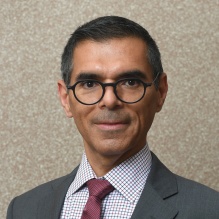
Carlos Federico Aguirre Cárdenas
Aguirre, a lawyer from Mexico, founded a law firm that largely represents foreign companies seeking to do business in Mexico, as well as Mexican companies handling international transactions. That led him to a deep interest in the United States-Mexico-Canada Agreement, the free trade agreement that replaced NAFTA and took effect in 2020. His research has centered around the role of rules of origin, the ways in which a country determines where an exported product originated and whether that product is eligible for duty-free status or reduced duties.
During the JSD program, Aguirre wrote three articles for academic legal journals: one on U.S. tariffs on imported electric vehicles, forthcoming in the Duke Journal of Comparative & International Law; one titled “Determining Country of Origin in an Age of Trade Disruption,” forthcoming in the Washington University Global Studies Law Review; and a third, which he’s still revising, with the title “Beyond the Spaghetti Bowl: A Building Blocks Approach to Rules of Origin.” (Academics, he notes, often call the international patchwork of rules of origin a “spaghetti bowl.”)
For Aguirre, studying in the United States has revolutionized his thinking about the law. “It really completely changed the way I address legal issues,” he says. “The way we write as lawyers in Latin America is to look at what is written in the statute. This is a different way of thinking about the statute: what was its intention and purpose, how it came to be, and also a critique of how the law is applied.”
As he looks to transition from practice to academia, Aguirre says the doctoral program was invaluable preparation. He credits his doctoral committee, chaired by Professor and Hodgson Russ Faculty Scholar Meredith Kolsky Lewis. Other committee members included Louis A. Del Cotto Professor David Westbrook and Associate Professor Jorge Fabra-Zamora. “It was an awesome experience working with them,” he says. “They were very supportive, and I really liked the guidance I received from them.”
“Carlos has been a pleasure to supervise,” says Lewis. “He is a veteran international trade lawyer and arrived with first-hand expertise regarding the complexities and implications of ‘rules of origin,’ the subject of his articles. The analysis varies from country to country and sometimes product to product due to a lack of international harmonization of these rules. He has worked hard to research and assess the existing literature on rules of origin and to develop his own theories and ideas for addressing this lack of harmonization. And he has produced excellent work.”

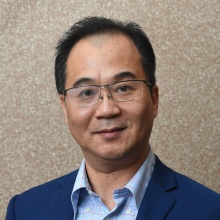
Peiwei “Peter” Wang
Wang, a longtime practitioner from southeast China, has practiced in the area of financial transactions and international trade. His JSD research takes a broader look at the sociopolitics of contemporary China, looking at government social controls, such as censorship, and the possibility of social transformation.
That entailed historical research, Wang says. “All history is contemporary history,” he says. “If you want to understand what happens today, usually you should look back, and you must establish a connection between history and today.”
Government censorship in China, he says, runs deep. “Censorship has played a very significant part in our whole history,” Wang says. Indeed, to have the freedom to investigate the topic, he had to do so in the United States. Drawing on the work of German legal philosopher Jürgen Habermas, his dissertation—titled “Censorship, Social Transformation, and Legal Modernization in China”—argues that China’s transformation into a modern state remains unfinished partly because censorship hobbles the free expression of ideas in the public sphere.
Wang successfully defended the dissertation before his faculty community, chaired by Professor Westbrook. The committee also included Professor Mateo Taussig-Rubbo and Associate Professor Paul Linden-Retek.
“The sweep and ambition of Peiwei's dissertation is breathtaking,” says Westbrook. “Surveying thousands of years of history, Peiwei discusses how the Chinese state, bolstered by legal and ethical traditions (translation is tricky here) has used censorship to govern, and to assert the legitimacy of such governance (i.e., censorship is seen as a positive force, not mere suppression).
“In consequence, however, Chinese civil society, distinct from the State, is underdeveloped,” Westbrook adds. “Drawing on Habermas, Peiwei argues that the modernization that China achieved in the 20th and 21st century is fundamentally incomplete precisely because of this underdevelopment. In order to participate in global modernity, China will have to change. As I said, breathtaking and maybe right.”
Wang credits the SUNY library system for providing invaluable assistance with his extensive research. “It’s a very, very powerful library system,” Wang says, “I borrowed over 100 books—Chinese historical books, contemporary books, English and Chinese versions of books; some books from a hundred years ago and some just published.”
Looking forward, Wang plans to stay in the United States and practice law. But he’ll continue to think, research, write and publish. “To my mind,” he says, “I can be both a law practitioner and a public intellectual.”