
Advancing justice, inspiring change
A conversation with Professor Heather Abraham
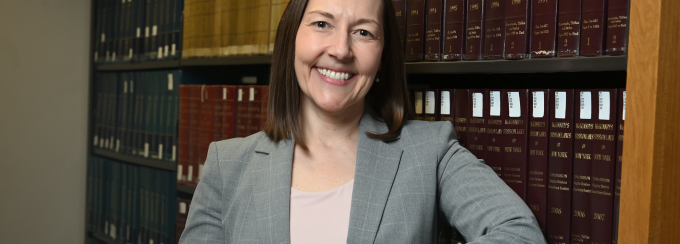
With her recent promotion to Professor of Law, Heather Abraham joins the ranks of UB School of Law's tenured faculty, a recognition of her exemplary contributions to legal scholarship, teaching and public service. Since joining the law school in 2020, Abraham has emerged as a leading voice in fair housing law, producing influential research on housing segregation, discrimination and civil rights while shaping the next generation of lawyers through innovative clinical education.
Abraham directs the law school’s Civil Rights and Housing Clinic, where students gain hands-on experience representing tenants facing eviction and engaging in impact litigation involving civil rights, fair housing and voting rights. A passionate educator, she challenges students to think critically about the law's role in society while developing the skills necessary to become thoughtful, effective and justice-minded attorneys.
In this Q&A, Abraham reflects on her academic journey, the questions that drive her scholarship, the rewards of teaching, and what lies ahead in her work at UB School of Law.
Congratulations on your promotion to Professor of Law. What does achieving this milestone mean to you personally and professionally?
My entry point into academia was a clinical teaching fellowship at Georgetown Law. I didn’t know what to expect! Yet, after just two weeks, I had this resonant feeling that clinical teaching was a fit. Eight years later, it’s gratifying to know that my intuition was correct. I especially enjoy how my work combines teaching, practice, and scholarship—it offers meaningful service opportunities and allows me to expose students to exciting new areas of law! It’s deeply fulfilling.
Your scholarship focuses on fair housing law, civil rights and access to justice. What drew you to these topics, and what continues to inspire your work today?
Fair, safe, and affordable housing access is a through-line in my research. I first discovered fair housing law as a research assistant to Prof. Myron Orfield at the University of Minnesota Law School. That work opened my eyes to the long, tortured history of enacting housing civil rights laws in this country. It’s still surprising to me how much more there is to research and write in this area that has yet to be explored.
Housing affordability is getting a lot more attention today—in public policy debates, in the media, and in daily conversations. Indeed, 2024 was the first time I recall housing being a central issue on national party platforms (and I’ve been paying attention since I was in fourth grade!).
Buffalo is a particularly critical place to do this work. As many people know, Buffalo’s neighborhoods are some of the most racially and ethnically segregated in the country. My work—and our clinic’s work—remain relevant every day, nationally and locally.
Recently, I took law students on a “Buffalo Civil Rights History Tour” (tip: watch for this at the next BPILP auction!). We visited the Freedom Wall and the Michigan Street African American Heritage Corridor, and the site of the first public housing complex for BIPOC residents, which was built during an era when public housing was explicitly segregated. Our conversations during the tour exemplified the ways I try to bring this history into legal education. Buffalo’s civil rights history and today’s patterns of residential segregation are intertwined. I love learning and sharing this history as a part of my teaching.
As director of the Civil Rights and Housing Clinic, you work closely with students on real-world cases. What do you hope students take away from that experience, both as future lawyers and as engaged members of their communities?
I try to impart that there’s not one single way to be a lawyer. It’s a highly personal craft, honed with years of practice.
I’m dedicated to the “harder” way of teaching—instead of telling students how to complete a task, I use non-directive, hands-on teaching methods. Students engage with their clients and grapple with difficult legal issues through a lot of back-and-forth with me. This method takes much more time, and sometimes it can feel inefficient, but it’s highly effective. I don’t want to simply tell students what to do. That’s a disservice to them.
Instead, I recognize that every lawyering task has some fundamental elements, but there is also an art to it. I want students to discover who they are as attorneys—what we call their “lawyering persona”— so they can quickly develop confidence in their own abilities. To do that, I give them formative feedback at each stage that acknowledges their strengths and growth while helping them focus on specific improvement areas. And—very importantly—I try to challenge this voice in their heads that tells them they need to master something the first time they attempt it! Few people can. The better approach, in my experience, is to encourage them to keep trying, keep learning, and keep improving.
What have you come to appreciate most about Buffalo and the UB School of Law community? What makes teaching UB Law students especially rewarding for you?
Arriving in Buffalo during a global pandemic was not an ideal way to build community. However, I was wonderfully surprised to discover Buffalo’s very strong nonprofit and legal services network. There is an impressive depth of expertise, caring, connection, and collaboration. I also felt quickly welcomed and accepted as someone who had something to contribute here.
At UB Law, my colleagues have invited me to define who I am as a scholar and pursue legal research that genuinely reinforces my service mission. Likewise, I’ve been able to shape a clinic centered on housing justice that presents students with opportunities to engage in impactful advocacy. Our impact can be seen in many ways across many metrics. Notably, we have served hundreds of clients providing pro bono legal services since I arrived. For dozens of them, we have saved them from eviction and probably homelessness. I’m grateful that UB Law supports this vital work.