
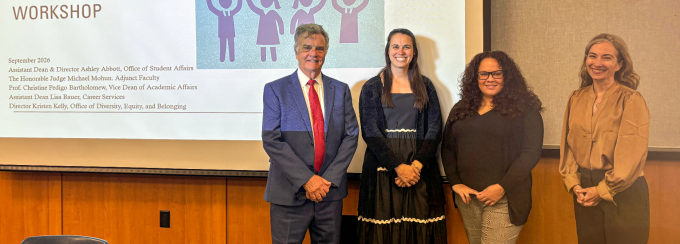
Left to right: Hon. Michael Mohun '80, Ashley Abbott, Kristen Kelly and Professor Christine P. Bartholomew at the law school's most recent scholarship workshop.
Opening doors to opportunity
A team approach to expanding access to scholarships
One size does not fit all when it comes to financing higher education. That’s why UB School of Law has expanded the financial counseling resources available to its law students, providing them with more targeted support.
In spring 2025, Ashley Abbott, director of student life, took on new responsibilities as assistant dean for financial counseling and student wellness, a fitting combination reflecting the significant role financial well-being plays in a student’s academic experience and overall wellness. She works with various members of the law school to provide a coordinated approach to financial counseling, helping students better understand their financial options and identify resources that best fit their individual situations.
Interested in supporting a scholarship?
Contact Karen Kaczmarski '89, vice dean for advancement, at krkacz@buffalo.edu.


Ashley Abbott, assistant dean for financial counseling and student wellness, and director of student life.
“Any type of financial uncertainty or debt concerns can weigh on a student's mind,” Abbott says. “When counseling students, we talk about the eight pillars of wellness: emotional, physical, social, spiritual, intellectual, occupational, environmental, and financial. Managing your money well, feeling secure about your current and future economic situation – that all affects your overall well-being.”
Abbott says that Dean S. Todd Brown recognized the need to embed financial counseling within the law school. Paying for school entails specific challenges for law students, and students expressed a desire for counseling tailored to their circumstances.
“Some have debt from before law school, from their undergraduate degree or any previous degrees,” Abbott says. “Some students had multiple jobs while they were undergrads. But law school is definitely more rigorous and academically challenging. Being able to not work and still support yourself financially can be difficult.”


Prof. Christine P. Batholomew, vice dean for student achievement and the law school’s William J. Magavern Faculty Scholar.
Financial counseling is provided through one-on-one sessions as well as group settings. Abbott and others organized two recent workshops for 2L and 3L students that covered topics such as navigating internal and external scholarship opportunities, where to find scholarships, how to apply for them, and how to make your application stand out.
She was joined by four others on the workshop panel: Professor Christine P. Batholomew, vice dean for student achievement and the law school’s William J. Magavern Faculty Scholar; Kristen Kelly, director of the law school’s Office of Diversity, Equity and Belonging; Lisa Bauer, assistant dean for career services; and Hon. Michael Mohun '80, a retired Wyoming County judge and an adjunct faculty member at the law school.
A passionate advocate for expanding access to opportunities, Mohun makes a point of getting to know students at the workshops and has taken a special interest in making them aware of available scholarships.
"Each student has a unique and fascinating story about why they chose to pursue a legal career,” Judge Mohun says. “As the State of New York's only public law school, we have a responsibility to help students recognize the value of their experiences and tell their stories in a compelling way."


Hon. Michael Mohun '80, retired Wyoming County judge and an adjunct faculty member.
Whether applying for internal scholarships available to UB Law students or external ones from sources such as the New York State Bar Association or the New York State Bar Foundation, students receive guidance throughout the process. For students navigating the financial demands of law school, the benefits of securing that support can be significant.
"Academic success in law school requires intense focus on studies, and financial pressure is one of the biggest threats to that,” Prof. Bartholomew says. “Scholarship funds can allow some students to step away from outside work and commit fully to legal study: in the class and through extracurriculars. That commitment matters most in the months before the bar exam, when sustained, undivided preparation makes the difference."
Abbott’s job as assistant dean is a bit of a juggling act. In addition to financial counseling and student wellness, she continues as the law school’s director of student life, working with students to organize events, and even teaching yoga classes in the law school’s Wellness Room. (She’s a certified yoga instructor.) Keeping track of the shifting financial landscape for law students ensures she has plenty on her plate.
“There has been a lot of recent changes in federal financial aid, including how much students are able to borrow,” she says. For example, the federal Graduate PLUS loan program was discontinued as of July 1.
“I work with UB’s financial aid office to help all of our students navigate those changes,” Abbott says.
For Abbott and the many other faculty and staff members who help with these efforts, the focus is on easing some of the pressures students face so they can devote more attention to their legal education. The results have been gratifying.
"The unwavering support of the law school team and its commitment to student success is yielding impressive results," says Judge Mohun. "Students are encouraged to explore a broader range of scholarship opportunities, including some they may not have considered in the past. I'm especially pleased to see the impact of heightened outreach to the New York State Bar Foundation. Half of the foundation's 2026 scholarship recipients were UB Law students, and for two years in a row, four UB Law students received Catalyst fellowships."