
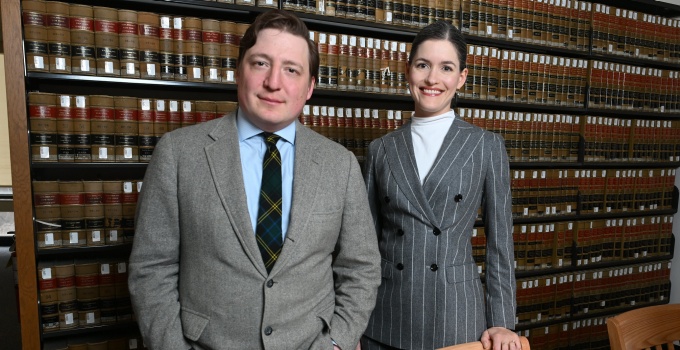
Associate Professors John Harland Giammatteo and Alexandra (Ali) Harrington.
OUR FUTURE
Faculty Research Informing Policy and Practice
For our faculty, the law is a living system, constantly evolving and always open to improvement. Their scholarship transforms ideas into action, informing policy and practice to serve the public good.
A Critical Eye on Immigration Review
A longstanding tension in jurisprudence is newly boiling over, and Associate Professor John Harland Giammatteo is asking why.
The friction lies in the federal courts’ review of the work of administrative agencies, particularly immigration courts. In a paper forthcoming in the Georgetown Immigration Law Journal, Giammatteo looks at recent decisions by the U.S. Supreme Court that have usurped much of the power of the administrative state. Specifically, he writes, the adjudication of claims in immigration law is happening according to a set of standards that don’t necessarily apply to other areas of administrative law, such as cases involving veterans’ or Social Security disability benefits.
For Giammatteo, a specialist in administrative law who teaches a practicum on asylum and appellate practice, the trend became apparent as he and his students examined cases of immigrants facing federal deportation proceedings.
“The focus of immigration courts is often bureaucracy, emphasizing efficiency and bureaucratic control at the expense of due process,” he says. “There are also political considerations layered on that really make it difficult for noncitizens appearing in immigration courts.” Even so, he says, some Supreme Court decisions have made removal proceedings less efficient and tougher on applicants’ claims.
Though administrative law procedures vary by agency, Giammatteo notes, because they’re dealing with different kinds of cases, the expectation has been that when appeals come before federal district courts, the norms for that review are harmonized. “I think immigration law isn’t exceptional. If we have administrative law doctrines, they should apply broadly, across immigration and other areas of adjudication.” For example, he says, a reviewing court should ensure an administrative adjudicator explains his or her reasoning in a particular case, no matter the subject area.
But under the Roberts Court, immigration cases are often subject to special treatment. “The Court treats immigration law as exceptional, preventing meaningful judicial review,” he says. Yet in cases about other administrative agencies, Giammatteo sees the Court deploying immigration as an example to undermine agencies and emphasize the role of courts.
The result, Giammatteo says, is that the Supreme Court treats immigration courts similarly to other administrative bodies when convenient rhetorically, and exceptional when it might matter most to noncitizens. “It’s a particular concern in immigration, where we have such strong political control and so many political implications happening at this moment.
“When you’re forcing immigration courts to quickly deny cases, you’d expect the administrators’ decision-making will become increasingly flawed or non-existent. The check on these flaws is judicial review, an independent review to make sure rights are protected. If we’re making it harder for federal judges to do their job in that context, we’ll have more people who are being denied their rights.”
Balancing Prosecutorial Power
In the Criminal Justice Advocacy Clinic taught by Associate Professor Alexandra (Ali) Harrington, students represent incarcerated individuals seeking reductions in their prison sentences. It’s an opportunity afforded by New York’s Domestic Violence Survivors Justice Act (DVSJA), which allows survivors of domestic violence to petition for resentencing if they can show their crime was related to the violence they suffered.
Looking at how the law has worked in the five years since its passage, Harrington noticed that the rates of success for resentencing petitions have varied greatly across the state. That led her to contemplate the outsize role that county district attorneys play in determining whether judges will grant a motion to resentence under this statewide reform.
Harrington’s article, titled “Second Look Myopia: State Sentencing Reform and the Local Prosecutorial Response,” is newly published in the Journal of Criminal Law and Criminology. Her research draws on data compiled on DVSJA cases by the Survivors Justice Project, a collaborative of New York State advocates, including directly impacted survivors and lawyers. The paper also lays out the national history of similar second-look laws.
“In some jurisdictions (of New York),” she writes, “the DA’s office has served almost entirely to obstruct the path to relief.” One example, she says, hits close to home: to date, the Erie County district attorney’s office has opposed every DVSJA resentencing case.
“The prosecutor’s role in the criminal legal system is outsized, because they make the decisions about how the case is charged,” Harrington says, “and very often that decision has ripple effects for the rest of the proceedings. They also have power over plea agreements, so— given a system where almost all cases resolve by plea—in the vast majority of cases, it’s the prosecutor, not the judge, who decides the sentence.”
In resentencing petitions, “the reality is that often when the DA opposes the petition, the trial court denies relief. Yet some of those cases are overturned on appeal,” she says, an indication that appellate courts recognize the merit to a resentencing application despite prosecutorial opposition. Appeals can take years, and the toll is harsh for a domestic violence survivor who has to endure a contested, adversarial hearing in which their experience is disbelieved and then wait for the case to resolve on appeal.
The remedy for this, Harrington argues, is two-fold: urge a shift in how prosecutors approach resentencing, and amend the DVSJA to cabin the grounds for opposition, and—more importantly—include a presumption in favor of resentencing.
Her paper comes in the context of the courts’ increasing recognition of the ways trauma such as intimate partner violence impairs people’s ability to make rational decisions. Political pressure to imprison more people and to impose longer sentences, Harrington says, complicates that evolution in the law. “Unless we reframe that,” she says, “it’s going to be incredibly difficult to realize these changes.”
Other Transformative Research


Protecting refugees
Paul Linden-Retek
Associate Professor and Co-Director of the Buffalo Human Rights Center
“My research concerns how the legal architecture of contemporary migration control might constitute torture. Deterrence, carrier sanctions, third-country removals and prolonged detention characterize policies of the Global North. Some practices, like pushbacks at sea, are sites of direct violence against migrants—and criticized as international crimes. But the attribution of torture applies, I believe, even in the absence of direct confrontation. Recently, scholars have argued that siege starvation is a war crime of societal torture, operating incrementally and at a distance, yet acting on the body to make political and human bonds impossible. The argument I pursue in forthcoming work is that global migration policy and the flawed refugee regime operate in much the same way and to similar effect—and are international crimes of torture on the same grounds.”

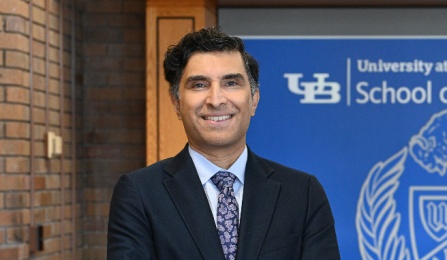
Safeguarding democracy
Manoj Mate
Professor
“My current research examines the failures of election law and electoral regulation to advance representation and other democratic values, and argues for a governance-based approach to election law to protect and optimize democracy. My other research explores how constitutional law frameworks have reshaped election law, how partisanship has impacted constitutional governance, the role and capacity of courts to regulate and protect democracy globally, and constitutional pathways to recognizing social and economic rights.”