
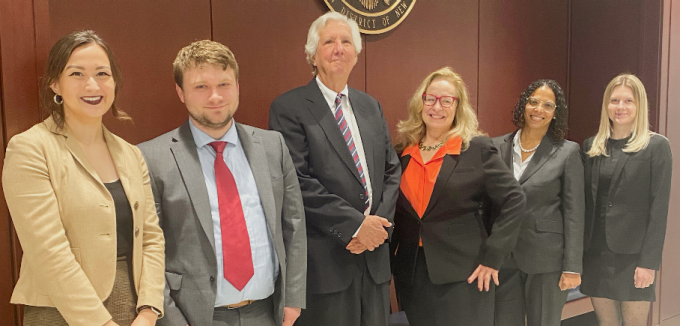
Law students help secure unemployment benefits for state employees
The case, brought with Empire Justice Center, ends COVID-era dispute, securing relief for thousands of New York workers
The University at Buffalo School of Law’s Clinical Legal Education Program along with Empire Justice Center have obtained a major settlement in a long-running federal case on behalf of non-professional school employees who were improperly denied unemployment benefits during the COVID-19 pandemic.
The case, Inzinga v. New York State Department of Labor, was filed in 2021 in the Rochester division of the U.S. District Court for the Western District of New York. The suit challenged the department’s determination that thousands of bus drivers, aides and other non-professional school employees were ineligible for unemployment benefits during summer 2020 because they allegedly had “reasonable assurance” of future employment.
Under the settlement, the department has agreed to sweeping relief for affected workers, including:
- Reversing the department’s findings that claimants made “willful misrepresentations” to obtain benefits.
- Recognizing that benefits received during summer 2020 were obtained in good faith.
- Eliminating repayment obligations for unemployment benefits.
- Ending efforts to collect any remaining alleged overpayments.
- Confirming that affected workers’ future benefits will not be affected.

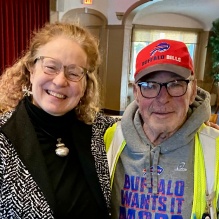
Prof. Kim Diana Connolly and James Inzinga
The terms of the settlement with the plaintiffs will be applied equally to approximately 2,000 non-professional educational employees as well as another 3,000 professional educational employees. The settlement will allow these school personnel to keep pandemic and unemployment benefits they received during the summer of 2020 from whom the department had sought repayment.
The agreement is expected to affect about 5,300 New Yorkers, many of whom have faced significant financial hardship and potential collection actions. The department has agreed to notify these educational workers that they may finally keep the unemployment benefits they received during the height of the pandemic.
Settlement ensures fairness for workers
For many workers, the stakes were immediate and personal: after losing expected summer employment during the pandemic, they relied on unemployment benefits to cover basic needs but later faced unexpected demands to repay thousands of dollars.
“We are proud to have reached a resolution that provides meaningful relief to thousands of impacted workers. This settlement reflects years of persistent advocacy and underscores the importance of ensuring that unemployment systems operate fairly, especially in times of crisis,” said Melinda Fithen, litigation director and lead counsel at Empire Justice Center.
Clinical education in action
UB School of Law’s Clinical Legal Education Program in partnership with Empire Justice Center litigated the case. Law students worked on the matter beginning in 2021, gaining hands-on experience in complex federal litigation, administrative law and access-to-justice advocacy.
“This case reflects the very best of what clinical legal education can do,” said Kim Diana Connolly, professor and vice dean for innovation, interdisciplinarity and community impact and a clinic director at the law school. “Our students committed themselves to this work over multiple years. Along the way, they learned how to navigate complex systems, advocate for clients and persist through uncertainty. They saw firsthand how the law affects people’s daily lives, and they helped secure a result that will make a real difference for thousands of workers across New York.”
“Working alongside the law students on this case was deeply rewarding,” said Peter Dellinger, an adjunct law faculty member at UB and retired Empire Justice Center attorney. “The collaboration brought together experienced public interest advocacy and an extraordinary group of student attorneys, all focused on ensuring that people were treated fairly under the law.”
Earlier contributors to the case included UB Law graduates Erin Barry ’20, for Empire Justice Center, and Vanessa Glushefski ’14, for the law school’s former Community Engagement Legal Clinic.
The case highlights broader issues in unemployment insurance administration and access to justice during the pandemic, Connolly says, particularly for non-professional school employees whose work patterns differ from traditional employment models. The outcome, she says, reinforces the importance of due process, accurate eligibility determinations, and ensuring that workers are not penalized for systemic failures during times of crisis.