
A critical voice for democracy
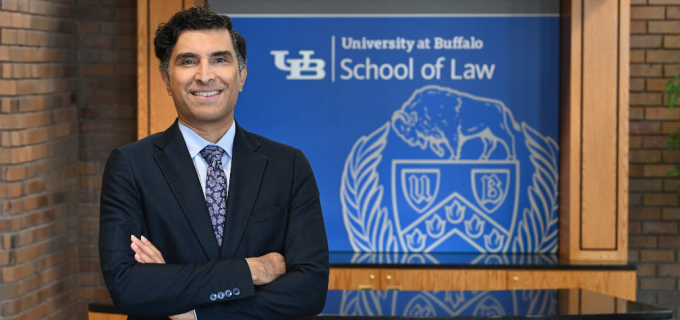
It’s been a year of big moves and bold milestones for Professor Manoj Mate.
Mate, who joined UB School of Law in 2024 from DePaul University College of Law, was recently named the Floyd H. and Hilda L. Hurst Faculty Scholar, an endowed faculty position, and is also affiliated faculty with UB's Center for Information Integrity and UB's Asia Research Institute. And in February, the constitutional law and election law expert assumed an important new role as director of the Edwin F. Jaeckle Center for Law, Democracy and Governance, the law school’s premier locus for research on law and democratic governance.
His appointment builds on the work of the Jaeckle Center’s previous director, James Gardner, SUNY Distinguished Professor Emeritus, who recently retired. And it reinforces the center’s vital inquiry into some of the most pressing issues of modern American democracy, including voting rights, redistricting, election integrity, campaign finance reform, state election law frameworks and electoral reform.
In addition to his J.D. from Harvard Law School, Mate holds a doctoral degree in political science from the University of California, Berkeley. Mate has held visiting roles at Harvard Law School; the University of California, Berkeley; and the University of California, Irvine. His experience in legal practice and policy work informs his scholarship on constitutional and election law.
Prior to entering the legal academy, Mate worked on voting rights reform at the Chief Justice Earl Warren Institute on Law and Social Democracy at Berkeley, and served as senior policy advisor to then-San Antonio Mayor Julian Castro. While at DePaul, Mate was appointed by Governor J.B. Pritzker to serve on the Illinois Racial Profiling Prevention and Data Oversight Board.
As he settles into this new role, we asked him to reflect on the work of the Jaeckle Center and its influential voice in the democratic conversation.
Congratulations on your appointment as director of the Jaeckle Center. What’s your overriding vision for what the center can accomplish?
The center will aim to play a key role in advancing research, scholarship and advocacy in election law and governance, including voting rights, redistricting, regulation of political parties, election administration, ethics and transparency, campaign finance reform, and other areas. It will serve as a forum for convening leading scholars, lawyers, policymakers, election administrators and advocates working in these areas.
American society is in the midst of shifting ideas around democratic governance. How can the work of academics inform or influence that ongoing debate?
Democratic institutions and processes in the United States and globally are currently facing key challenges that impact the integrity of elections, representation and governance. Interdisciplinary research can inform and guide litigation, policy reform and advocacy aimed at improving democratic representation, accountability and responsiveness.
How do you see the center deepening the conversation among faculty and students at UB Law?
The center will seek to educate the UB community and beyond on key issues and debates involving the intersection of law and democracy through talks, conferences and events and initiatives featuring scholars, policymakers and reformers. It will seek to bring together faculty working on these issues at the law school, the university and beyond, to enrich the law school experience and create opportunities for law students to engage with scholars and experts in law and democracy.
It’s not just law but the social sciences that undergird the work of the Jaeckle Center. You have bachelor’s and doctoral degrees in political science. How has that training shone light for you on how the law works in practice?
My doctoral training in political science has helped guide my own interdisciplinary research on law and democracy, constitutional law and comparative law. My research critically examines and assesses the role courts and other actors play in advancing and undermining democratic values and processes and how they enforce both constitutional norms and congressional legislation. In addition, my scholarship has been informed by my experience practicing election law and my policy experience in state and local government.
While constitutional structure and rights are foundational, it is impossible to fully understand election law and political regulation without examining the social, political and economic contexts that inform the law and practice of democracy. Party politics, partisan polarization, social movements including the civil rights and voting movements, and other developments have shaped constitutional change, judicial decision-making and reforms that have expanded voting rights and democratic inclusion. At the same time, political movements and forces have also sought to restrict voting rights and democracy in key moments. I look forward to convening Center events and programs that explore these topics and current developments in the coming years.