
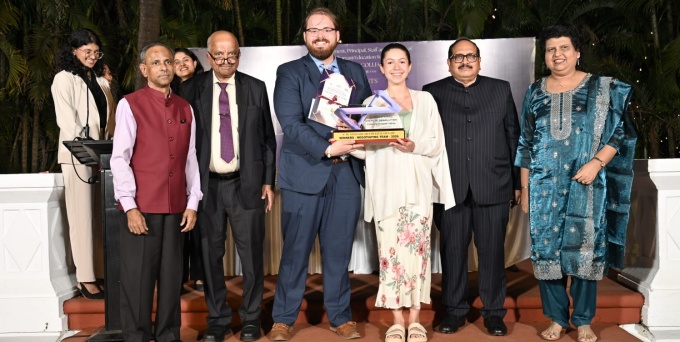
Richard Neri '26 and Francesca Manzella '26 receive top honors.
UB Law team wins big in international dispute resolution competition
While Western New York shivered through a brutal January freeze, two UB Law competitors rode a hot streak to victory in an international advocacy competition held in India.
The team, third-year students Richard Neri and Francesca Manzella, took top honors in the Lex Infinitum International Dispute Resolution Competition, held Jan. 22 to 24 at V.M. Salgaocar College of Law in the southwest India region of Goa. The UB Law competitors were the only Americans in the 24-team field. They prevailed through two preliminary rounds, quarterfinals, semifinals and a final-round victory over a team from National Law University in Delhi.
The win was a culmination of a month’s intensive preparation with their coaches, Andrew Cegielski ’25 and Katie England ’25. Throughout the competition, Neri acted as the client in each scenario and Manzella as the advocate—roles that required each of them to strategize, communicate clearly and think creatively.

With their coaches (Left to right: Katie England ’25, Richard Neri '26, Francesca Manzella '26 and Andrew Cegielski ’25).

“It’s all focused on collaboration, and the focus truly is on the parties, on the client being able to have a human conversation with the other client,” Neri says.
That’s especially true for alternative dispute resolution practiced in Asia, they say. “Mediation practice there is very client-focused. It’s about having an honest conversation with the other side,” Manzella says. “In the United States, often the parties meet in separate rooms and mediators go back and forth, trying to reach an agreement. But in the rest of the world, the style is more, let’s understand each other and have a human conversation.”
The preliminary sessions were held at the host law school, but the finals were contested before a large crowd in an auditorium at Goa’s district court. That made things tricky, Neri and Manzella say, because it was hard not to be distracted by the audience. Scoring included maintaining eye contact with the other party. “I tried not to look at the crowd,” Manzella says. “You’re supposed to be looking in the eyes of the other party the entire time.”
The competitors had access to the general facts of each scenario in advance, in cases that ranged from biotech research to television broadcast rights, and from a land dispute to a complex negotiation between a hospital network and an artificial intelligence company. But a half-hour before each mediation session they received a set of additional confidential facts, so they had to adjust strategy on the fly.
That difficulty factored into the work the two coaches did with the team at crunch time. “With those confidential facts, often you find really important information about what you’re willing to settle for, your bottom line, what you’re hoping to get out of the negotiation,” England says. “And getting those facts right before the negotiation helps students learn to think on their feet. It’s important for advocates to be able to learn to digest information really quickly and be able to still advocate strongly for whatever those new pieces of information include.”
Another thing they learned, Cegielski says, is to lead with feelings rather than facts. “I think we won because we placed such an emphasis on the client’s interests,” he says. “We always started with the clients stating what they were feeling and what their goals were. So Rich would say something like, ‘I feel frustrated. My interests today are …,’ and that really resonated.”
The victory came with a prize of 50,000 rupees, about $550. But the competitors say the experience was rich in many ways.
“We made so many friends with all the different people we met,” Manzella says. “Goa is beautiful, with amazing beaches and restaurants and historical monuments. And it was 85 degrees. I would love to go back.”