
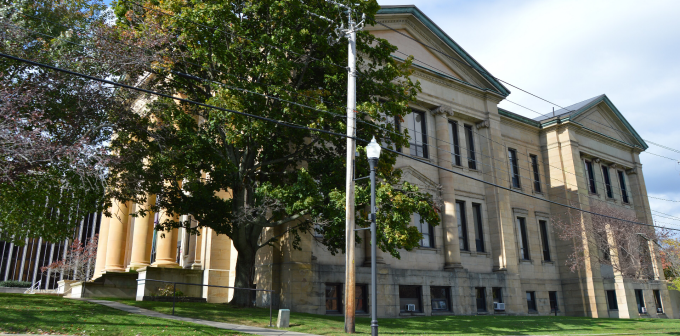
Chautauqua County Courthouse, New York.
Expanding opportunities for students to pursue rural practice
An ambitious initiative to introduce law students to the unique rewards of rural practice is already yielding opportunity through internships and scholarship support.
Spearheaded through the efforts of Hon. Michael Mohun ’80, a retired Wyoming County judge, and Bernadette Gargano, vice dean for experiential education and social justice initiatives, the UB Law Rural Justice Initiative is a step toward addressing a major access-to-justice problem in New York’s rural counties. Nearly 50 of New York’s 62 counties have fewer than 200,000 residents. Urban counties may have 40 residents per practicing lawyer; in rural counties, the ratio might be more than 200 to 1.
One part of the solution is broadening students’ horizons so that future practitioners recognize the benefits of pursuing a legal career in rural settings.
“Some of our students are from rural counties, so the idea of serving their neighbors has great appeal,” says Marc Davies ’03, the law school’s senior associate director for career services. “But also, there’s more of an opportunity to balance your professional life with outside interests and hobbies, especially if you like the outdoors and nature.”
Davies and the Career Services Office have placed special emphasis on Rural Pathways Legal Internships, newly established summer placement opportunities created by the New York State Office of Court Administration. Of the 20 internships available this year, five were given to UB Law students—the most of any law school in New York State—partly because CSO promoted the program heavily to first- and second-year students looking for summer placements. In advance of an October application deadline, the office hosted a panel of practitioners who talked about what it’s like to practice in rural settings.
In addition to Judge Mohun, the panel included New York Supreme Court Justice Grace M. Hanlon from Chautauqua County, Wyoming County Family Court Judge Keith Kibler, and Judd Krasher, chief of staff for the New York State Supreme Court’s Appellate Division, 3rd Department.
“They shared their lived experience serving rural communities,” Davies says—“what it looks like and why it’s beneficial. They discussed the challenges and needs in these areas. They gave clear insights into what those communities are lacking in terms of legal representation and access to attorneys, and what it means to them personally to be able to provide the services that they do.”
Additional efforts to expand pathways to rural practice include providing scholarship support for outstanding students with an interest in serving those areas. That includes the new Norman P. Effman (’68) Scholarship, established by Judge Mohun through the New York State Bar Foundation. Eligible law students must demonstrate “an interest and intent to work in a rural locale representing indigent individuals who are litigants in family court, criminal court, or other courts where the individual may be facing civil legal issues.”

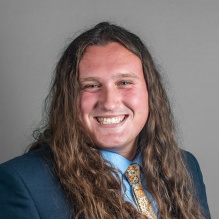
Connor D. Whitney ’26
As the inaugural recipient, Connor D. Whitney ’26 now has a $5,000 leg up on his law school tuition and an opportunity to further his experience with rural practice.
“I’ve always wanted to do rural criminal defense,” says Whitney, who grew up in the 3,000-population town of Cuba in Allegany County. “That’s been my dream the whole time.”
Having served an internship as a UB undergraduate at a rural public defender’s office, he says, made clear how great the needs are for talented legal representation. “You see how they’re understaffed and how the people they serve really need the help,” Whitney says. “A majority of people in those counties qualify for public defense and seeing that gap in resources really pushed me.”