
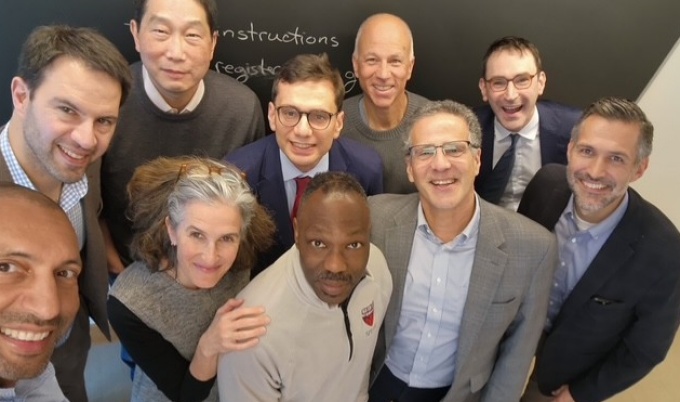
Gardner with the many scholars and leaders who led discussions at the event.
GardnerFest
Celebrating a voice of democracy
Election law may be a niche discipline, but its scholars shape the very foundations of democracy. Few have done more to define the field than SUNY Distinguished and Bridget and Thomas Black Professor James Gardner. So, when Gardner announced his transition to emeritus status, colleagues across the country gathered to honor a career that has reshaped how scholars—and citizens—understand American democracy.

Gardner led a discussion on digital communications and democratic backsliding.
Dubbed GardnerFest, the Nov. 14 event was held in the august confines of Harvard Law School. It was organized by Guy-Uriel Charles, Harvard’s Charles Ogletree, Jr. Professor of Law and director of the Charles Hamilton Houston Institute for Race and Justice.
“We organized GardnerFest to honor the work of Jim Gardner and celebrate his tremendous accomplishments in election law,” says Charles, with whom Gardner co-edited the casebook Election Law in the American Political System (Aspen), now in its third edition.
“Jim has been a pioneer of the field,” Charles says. “He is a brilliant constitutional theorist. He forced election law scholars to grapple with profound and essential questions such as the problem of authoritarianism in American politics, the limits of federalism, the cultivation of virtue, and addressing the gap between ideal democratic theory and the reality of democratic practice.
“GardnerFest allowed us to express to Jim how much we appreciate him and his mentorship, and how much we have learned from him over the years. It also gave us an excuse to talk about the state of American democracy and to think through different paths it might take.”
The gathering focused on significant recent articles by Gardner as well as his classic 2009 book What Are Campaigns For? (Oxford University Press). It brought together a dozen scholars to share ideas, including some new thinking by the honoree.
“My hope was not that people would talk about my prior work,” says Gardner, whose retirement takes effect in December, “but that they would give some attention to the ideas that are focused on in the prior work, and we would have a collective high-level discussion of some of the things that interest me. It was a very good group, with people from all different generations—people older than me, some peers and a couple of junior scholars who have been influenced by my work.”
The colloquium comprised four roundtable discussions, culminating in one called “Digital Communication and Democratic Backsliding: The Rise of Deilocracy.” Gardner himself was the presenter, and he used the occasion to wrestle with some nascent ideas—yet unpublished—about the state of American democracy.
The “deilocracy” of the title comes from the Greek word deilos, meaning timid or fearful; in Gardner’s coinage, deilocracy is rule by the most timid among us.
“Circumstances require us to rethink our theory of democracy,” he says. “The idea I’m turning over in my mind is that the internet has changed communication in democratic societies in a way that elevates the most fearful people to a position of power.” The respondents, he says, had interesting comments about online culture, including findings that older people are more likely to pass along misinformation, and discussion of the role of social media influencers in this equation.
As Gardner organizes the list of projects he plans in retirement, he says GardnerFest brought home the reality of the transition. “I was not eager to hear people spend a lot of time praising me or my work,” he says. “That just makes me uncomfortable, although it’s nice to hear.
“The day after, I felt a little different. The page is turning.”