
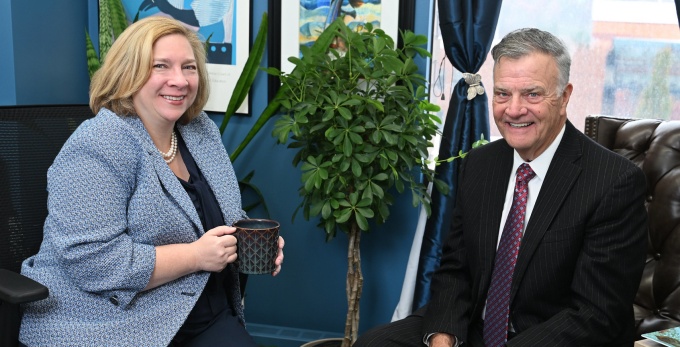
Bernadette Gargano, vice dean for experiential education and social justice initiatives; and adjunct instructor, Hon. Michael Mohun ’80.
Building toward justice in rural counties
Sometimes ensuring access to justice is a numbers game.
And in New York’s rural counties, the numbers can be daunting. Only 4 percent of the state’s lawyers serve in rural areas, where nearly one-fifth of the population lives. And of those who do serve, many are approaching retirement age. The result is a welter of problems: too few lawyers to serve as assigned counsel, too few specialists available in needed practice areas.
A UB School of Law initiative in conjunction with the state’s Office of Court Administration is seeking to rebalance the scales. The UB Law Rural Justice Initiative, led by Bernadette Gargano, vice dean for experiential education and social justice initiatives; and adjunct instructor Hon. Michael Mohun ’80, aims to show law students that rural practice offers unique satisfactions and plenty of opportunity.
“Not only is there a current crisis in representation, but the crisis is getting worse as attorneys retire,” says Gargano. “Critical constitutional protections are also at issue, especially in mandated assigned counsel programs for criminal defense and family court issues involving children. And nearly 40 percent of rural attorneys report being unable to make referrals because no suitable attorneys are available in clients’ geographic areas.”
Nearly 50 of New York’s 62 counties have fewer than 200,000 residents, says Mohun, a retired judge in Western New York’s Wyoming County and member of the law school’s Dean’s Advisory Council. Urban counties may have 40 or so residents per practicing lawyer; in rural counties, the ratio might be more than 200 to 1. That, he says, poses substantial impediments for residents who need legal help, whether in civil or criminal matters.
By attracting newly admitted lawyers to practice in rural counties, the law school's Rural Justice Initiative hopes to take a step toward equity. “This could be a sea change in driving students to rural practice,” says Mohun. “We want to introduce these young law students to the rural practice world, and we want them to be embraced by these communities.”
The multifaceted initiative envisions several ways to introduce current students to rural practice.
Under a program called Rural Pathways, the Office of Court Administration will fund paid summer internships for law students in rural counties. Next summer, 18 counties will have intern placements in their court systems, including one each in Wyoming and Chautauqua counties. To make it easier to find housing, they’ll be invited to live in residence halls on the nearest State University of New York campus.
Additional aspects of the law school’s initiative include developing a curriculum geared toward rural practice and a proposed Rural Justice Scholars program, modeled after the highly successful Pro Bono Scholars Program. Fellowships will be made available to third-year law students who’ll spend the final semester of their 3L year working full time in a rural legal setting, either a public defender’s office or the district attorney’s office, earning both a salary and academic credit. Students may also be able to take the bar exam in February, jump-starting their legal careers.
State organizers envision connecting law students to mentors in private law firms in rural counties and efforts to persuade existing lawyers in urban areas to relocate to rural counties.
Mohun says these combined efforts can both raise awareness of rural practice and dispel some false assumptions. “Perhaps rural practice has been seen as not glamorous,” he says. But he notes that one can make an excellent living as a country lawyer.
Norman Effman ’68, former public defender for Wyoming County, is retired from that role but still carries a caseload. He says the rewards of rural practice often go unappreciated in the larger legal community.
“We’re doing a lot of recruiting to get people interested in the work, to get them do it and see how exciting it can be,” Effman says. “Most people want something that they feel comfortable with, where they’re going to get support, mentoring, monitoring and not be thrown to the wolves. Getting people to understand what can be a positive, fulfilling experience in a rural setting, it’s part of the education process that is lacking.”
Leah Nowotarski, who has been Wyoming County’s public defender since 2023, says, “You get a lot of opportunities in rural practice that you don’t get in the city. You can build a rapport with the DA and law enforcement in rural areas.”
Vincent Hemming ’00, joined the Wyoming County District Attorney’s Office right after his law school graduation and has been there ever since. Hemming, recently elected to the DA position, says hiring has sometimes been a struggle. But, he adds, “when people do come to interview, you can show them the opportunity to work out here, how it’s a good environment and a good court system, and they stay.”
Not to mention, he notes wryly, unlike in the city, parking is a snap.